
 Menu
Menu
Click Here to Sign Up for Your Free Muscle Building Magazine
Dan Duchaine Interview
DAN DUCHAINE UNCHAINED
THE "GURU" BREAKS THE SILENCEBy Scott Harrah
Originally published in MuscleZine
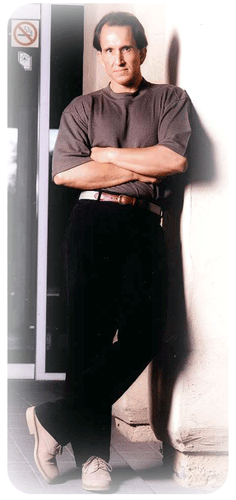
Dan Duchaine, in the past decade, has lived the sort of life we read about in pulpy suspense bestsellers. Yet there's nothing glamorous about trafficking illegal drugs into the United States, as he'll tell you. Duchaine first did time in prison for being involved in a Mexican conspiracy to manufacture anabolic steroids for illicit export to the U.S. He then spent 36 months behind bars as penance for interstate sales of GHB-an over-the-counter sleep aid available in health-food stores . Today he's hailed as the "guru" of sports medicine and nutrition, with a top position at Next Nutrition and a hot column in Muscle Media 2000, a magazine that 's gained both scorn and respect for its honesty about natural supplements and steroids as well as anabolic therapy for AIDS patients. He is the author of Body Opus and The Underground Steroid Handbook I & II. All this acclaim is not bad for a guy like Duchaine, whose formal training is in theater, not sports medicine. Duchaine failed miserably as an amateur bodybuilder in the 1970s, has been married three times, and recently admitted to MuscleMag that he has a guiltless love of junk food and is really a "lesbian trapped in a man's body," as he prefers dealing with women as oppossed to male-bonding with egotistical guys in gyms. These days, Duchaine doesn't even hang around with bodybuilders, preferring to keep a low-profile existence in San Diego.
MUSCLEZINE: First off let's talk about your upcoming seminar at Strong and Shapely Gym. What do you talk about at your seminars? Do you give a presentation on natural supplements and growth-enhancing drugs, or is it mostly a Q&A session?
DAN DUCHAINE: It's usually things I've been working on that I think might be important to the audience. It may be anabolic steroids or some derivative of that. However, you have to gauge by your audience. Obviously if you have an audience with a lot of women, then they're not going to be interested in steroids, so I try to do a mix of information about cutting-edge supplements that may not even be out yet or may be about to appear. That doesn't mean I am going to sell them!
MZ: Let's go over some basic background because not all of my readers may be familiar with you. When did you first become interested in bodybuilding, and particularly sports medicine?
DD: Well, I have no formal training in either. I have a college degree in theater arts. For a short time after college, I competed as a bodybuilder around the New England area. From about 1977 to 1981. After that, I decided that I had been a miserable bodybuilder, even though I had done all the right things-going to all the steroid doctors in L.A., finding European steroids. I used my fair share of steroids, but I still wasn't very good. Obviously something wasn't working, and the doctors and the pharmacists couldn't really answer my questions. So I started looking into steroids on my own. I happen to be a pretty bright person, probably "near genius" on anything I've pursued. Then the laws changed about 1990 and steroids weren't as accessible. At that time people became interested in natural supplements. Up until 1990, there was nothing interesting on the supplement market. Everybody wants to buy a supplement as if it were a drug, but up until then, most of them were concentrated foods. I always thought, "Why eat protein or egg powders when you can just eat an egg? Why have milk protein powder if you can just eat cottage cheese?"
MZ: Now, for those of my readers who aren't familiar with you, can you talk about the time you did in prison?
DD [laughs]: Which time, Scott? [Laughs again.] I went to prison twice. I went to prison in 1987. There was a very odd time in my life, where I started doing a small retail steroid operation. I had a price list going out in the mail, and it grew out of having friends who were steroid dealers. They wanted to get mail-order customers. They mailed out their price list to people who had bought my Underground Steroid Handbook. For the longest time I said, "I'm not going to sell steroids because I don't know where to get them." Then there was a point in my life where I left my first wife. I left with nothing, because she took everything. I was a little low on cash, and had an acquaintance who had the ability to get anabolic steroids. So I said I'd throw my price list in with the others. I actually probably undercut the others, so my list was much more attractive. Mostly the customers were people who would buy $100 to $200 at a time. A couple things happened. I started getting a lot of things from a steroid dealer in Europe who wanted to move product through America. He extended me some credit, and I couldn't do all the selling myself so I started wholesaling things out to other dealers. And Dianabol, the most popular oral steroid withdrawn from the market, both the generic and the trade name...I was looking around for a replacement. All of the replacements were very poorly done. You could pick up a tablet and write your name on a chalkboard. It was that bad. There were some tablets out of England and India that were very nice. Guys would show up at the L.A. airport and I'd get a few hundred bottles, but I'd never know when they'd come back.
Then I had the opportunity to work with someone I'd never met before. He was working with a small drug company in Tijuana that was making generic drugs for the Mexican market. They specialized in antibiotics like Tetracycline. We had a meeting one day and he said, "Could you use some Dianabol?" I said, "Damn right I can, but I'm not a drug smuggler." He said, "We can get it over the border for you." I told him that I was mostly a retail guy and asked him how much I'd have to buy. He said 5,000 bottles. I said, "I don't know. That would last me a year." Then I talked to a friend of mine, and we agreed that we could move it out of Mexico, so that's how we started with this manufacturing company, Laboratories Milano. For a short time, my job was to dream up the kind of steroids they'd make. I'd find an example on the market and maybe change the packaging and labels. After a half a year, I noticed the U.S. Federal Government was starting to follow me around. And I thought, "This is not a hobby anymore." So I left that whole conspiracy and left the steroid business and moved to San Francisco. I started working with Champion Nutrition. About the middle of 1987, the government swept up everyone who was ever involved with that conspiracy and I happened to be at the beginning of it. I did 10 months in prison that time.
After I was released on probation, I stupidly in about 1991 met up with a friend who had a longevity club selling GHB. The GHB supplement used to be available in health-food stores until the FDA realized it was really a sleep aid. It could knock you out in 20 minutes. Even though they can't really ban a drug-only Congress and the DEA can do that-they can enact these weird Catch-22 labeling laws. So as long as you're selling GHB in your state, they can't touch you, but if you ship a bottle of a substance they don't really like across state lines, there is no possible way to fulfill the labeling requirements. So we just didn't put labels on the GHB bottles, with no claims whatsoever. We just called them research chemicals. The government kind of got pissed about that. Unfortunately it was supposed to be a finite thing. We had very little GHB left. We had a little Clenbuterol at the same time. It was an already established longevity buyer's club. Unfortunately for us, one of the customers was an undercover FDA agent so I got my tit caught in the wringer. It was a stupid thing for me to do. Even though I can argue that it wasn't worth 36 months because it wasn't really an illegal drug, hey-I take the responsibility. I did my time. I learned a lot in prison about how to make money in legitimate avenues. I probably made more money in prison than the prison officials!
MZ: Is there anything still legally pending against you that you can talk about?
DD: No, I'm on supervised release. All my indictments are behind me.
MZ: Do you know of a recent surge of counterfeit steroids in the U.S.?
DD: I don't know. First off, I'm in San Diego, and I don't train at a bodybuilding gym. I'm pretty reclusive. I have an office here, but I don't get many phone calls. And I don't see many people around me using steroids on a day-to-day basis. Also, in San Diego, most of the steroids that are available are real and out of Mexico. I have no idea what's counterfeit in other parts of the country, but I can tell you about what's available in Mexico that's counterfeit because even when Laboratories Milano closed down, all the packaging and labels were available to some of the minions. If you go to Tijuana or any of the border pharmacies, you'll see odd steroids that look like they're from France or Germany but they're total fakes. At least when we were making steroids, you'd get exactly what it said on the label. But now you just have bottles with binders and talcum powder.
MZ: What should people look for if they suspect something might be counterfeit?
DD: I'd probably discount anything in bottles of tablets. It's easiest to put 100 tablets in a bottle. Anything that's injectable that's a 10 cc vial is also probably counterfeit. However, if you can find single-use ampoules or tablets on a foil or plastic strip, those are pretty much real all the time in the U.S. However, in England, a lot of ampoules in foil or plastic are being counterfeited, but in America that's rare because most steroids coming into this country are smuggled here from Russia by the Russian Mafia in Brighton Beach, Brooklyn. I can't say anything bad about the stuff the Russian immigrants in Brooklyn are selling because the quality is outstanding and the prices are reasonable. You can buy Growth Hormone at $35 for four I.U.s , and the best you can do otherwise is $80 for four I.U.s out of Mexico.
MZ: So what the Russian Mob in Brooklyn are selling is real?
DD: Yes, but eventually they'll wise up and won't give a shit and will realize they can make money selling fake stuff. That always happens. So, while the Russians are offering real stuff, people are going to be able to buy nice quality things.
Click Here to Sign Up for Your Free Muscle Building Magazine
Muscle Building Magazine
Muscle Supplements
Legal Anabolics Stack
Muscle Building eBooks
Weight Lifting Articles
Weight Lifting Workouts
Bodybuilding Techniques
Muscle Building Tips
Muscle Building Diets
Muscle Building Recipes
Bodybuilding Personal Ads
Bodybuilder Chat Room
Muscle Building Links
Contact Us
Disclaimer: This information is for entertainment purposes only. We strongly recommend that you consult a physician before beginning any exercise program. MuscleNet.com is not a licensed medical care provider. The reader should understand that participating in any exercise program can result in physical injury and agrees to do so at his own risk. The findings and opinions of authors expressed herein are those of the author and do not necessarily state or reflect those of MuscleNet.com.